
What role can the ocean play in removing CO₂ from the atmosphere?


The ocean naturally absorbs large amounts of CO₂. Scientists are therefore exploring ways to enhance that natural uptake. This includes investigating natural ecosystems such as seagrass meadows and salt marshes, as well as technological interventions that could help remove more CO₂ from the atmosphere.
Interest in these techniques is growing as it becomes clear that emissions reductions alone will not be sufficient to achieve long-term climate objectives. At the same time, important questions remain regarding the effectiveness, scalability and potential impact of these techniques on the marine ecosystem. This makes a well-considered policy framework essential.
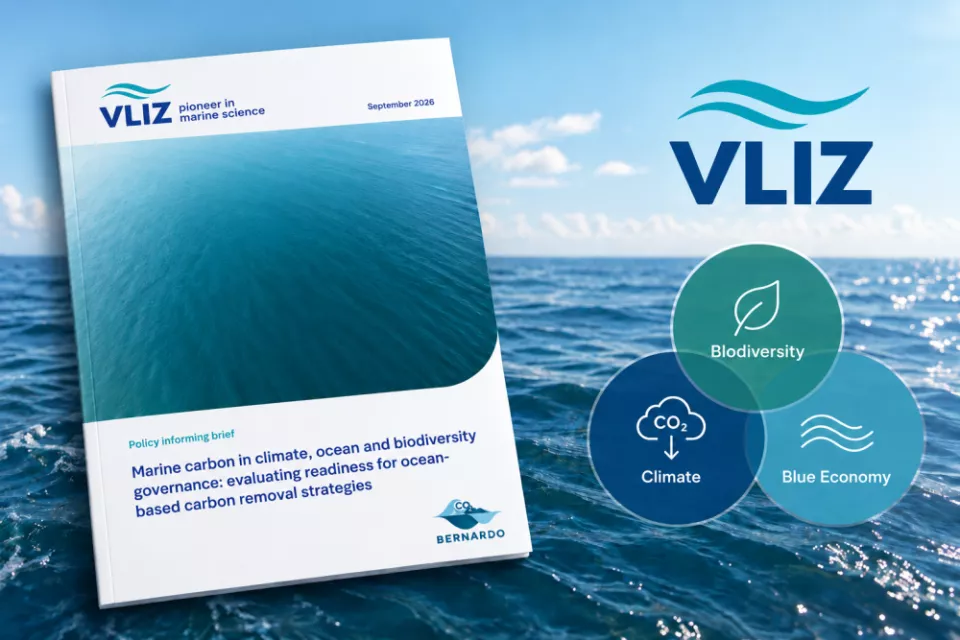
In a new policy brief, the Flanders Marine Institute (VLIZ) examines the extent to which current policy frameworks are prepared for these developments. The document maps how climate, ocean and biodiversity policies currently address such techniques, and identifies the key gaps that remain.
No integrated policy framework
The analysis shows that none of the existing policy domains is currently fully equipped to assess such techniques in an integrated manner. Climate policy mainly focuses on carbon accounting and emissions reporting, while ocean and biodiversity policies are primarily concerned with ecosystem management, spatial planning and limiting human impact.
As a result, the role of marine carbon is often only partially taken into account. Clear frameworks are still lacking, particularly for newer and more technological approaches, to assess their effectiveness, scalability and potential impacts on the marine environment.
Need for reliable monitoring
An additional challenge is measuring carbon flows in the ocean. Unlike many land-based activities, the ocean is a dynamic and transboundary system, making it difficult to determine how much CO₂ is actually absorbed and how long it remains stored.
According to the authors, there is therefore a need for robust systems for monitoring, reporting and verification. These are an important prerequisite for accurately assessing the contribution of such techniques to climate objectives.
Linking climate, nature and the blue economy
Finally, the policy brief highlights growing international and European attention to the role of the ocean in the climate transition. According to the authors, this creates opportunities to better connect climate mitigation, biodiversity protection and the blue economy.
A more integrated approach, supported by scientifically grounded monitoring and verification systems, can contribute to better-informed policy decisions regarding future climate solutions at sea.
Do you have any questions about this policy brief? Please contact Steven Dauwe (VLIZ).
Context
This policy brief was developed within the BERNARDO project. In this project, companies and research institutions collaborate to gain a better understanding of carbon flows in the Belgian part of the North Sea. BERNARDO investigates how much CO₂ the Belgian North Sea absorbs, stores and releases, and how this knowledge can contribute to applications within the blue economy.