Floating solar shows strong potential in Belgian offshore wind farms


Belgium has built up a strong position in offshore wind over the past two decades. As more renewable energy moves offshore, the question is no longer only how much energy can be produced at sea, but also how marine space and offshore infrastructure can be used more efficiently.
This is where the SWiM project comes in. The project brought together six partners from industry and science to investigate how Offshore Floating Photovoltaics (OFPV) could be integrated into offshore wind farms in the Belgian North Sea in a technically feasible, environmentally sustainable and spatially efficient way.
By combining offshore wind and solar within the same area, SWiM explored how different forms of renewable energy could complement each other while sharing marine space and infrastructure.
Mapping the opportunities
Within Work Package 5, led by Blue Cluster, SeaVolt carried out a technical study to quantify the potential for floating solar in the existing Eastern Zone and the future Princess Elisabeth Zone. The study focused on technical potential, taking into account factors such as the available space between wind turbines and the capacity of the offshore electrical infrastructure. It did not assess cost-effectiveness or economic feasibility.
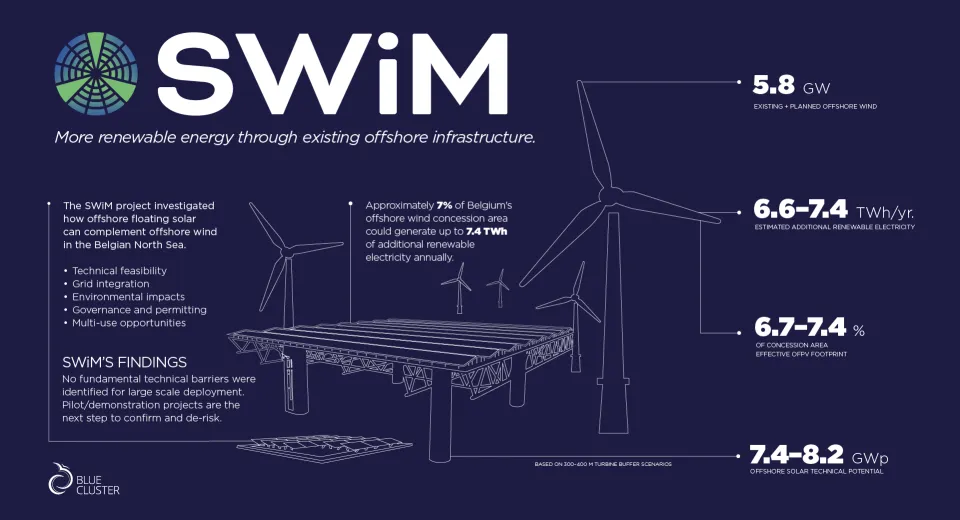
In the study's base scenario, up to 1.5 MW of floating solar could technically be integrated for every 1 MW of offshore wind, with approximately 6% curtailment of solar production. Depending on the safety distance maintained between floating solar installations and wind turbines, this translates into a total technical potential of approximately 3.2 to 8.2 GW of floating solar capacity across Belgian offshore concessions.
A substantial boost in renewable energy production
At a distance of 300 metres from the wind turbines, floating solar could generate around 7.4 TWh of additional renewable electricity per year. For the existing Eastern Zone alone, this could increase annual renewable electricity production by approximately 45% compared with offshore wind production in 2025.
In addition, the potential could be even higher under more optimistic assumptions. A scenario based on larger future wind turbines, increased floating solar density and 2 MW of solar capacity per MW of wind resulted in approximately 11 GW of offshore floating PV and almost 9 TWh of electricity production per year.
Space is not necessarily the main constraint
One of the most striking conclusions is that available electrical grid capacity, rather than available marine space, is likely to become the main limiting factor for large-scale deployment.
In other words, there appears to be considerable physical potential for floating solar within Belgian offshore wind concessions. The challenge is how that additional production can be integrated into the offshore electrical infrastructure.
At the same time, this finding points towards an opportunity. Combining wind and solar could allow existing and future offshore infrastructure to be used much more intensively, rather than developing separate infrastructure for each type of renewable energy.

A step towards multi-use at sea
The significance of the SWiM findings goes beyond floating solar itself. Offshore wind zones have traditionally been developed primarily around a single activity: producing wind energy. SWiM shows how these areas could gradually evolve towards multi-use areas, where compatible activities share marine space, infrastructure and services.
Combining offshore wind and floating solar could be one of the first concrete steps in that direction. And once different forms of renewable energy can successfully coexist within the same offshore area, it becomes possible to consider how other compatible activities could be integrated as well.
From multi-use to Mariparks
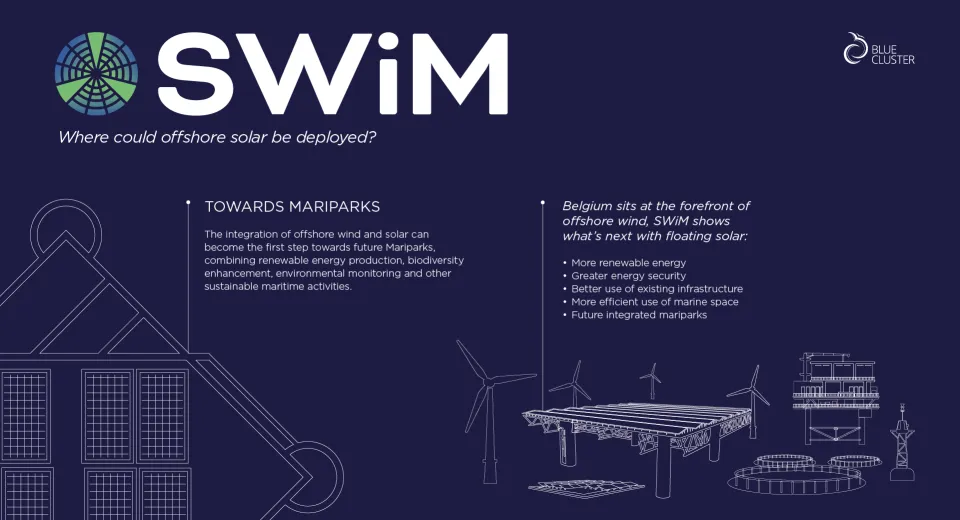
This is where the concept of Mariparks comes into play. A Maripark is an integrated offshore area in which renewable energy production provides the backbone for several compatible blue economy activities. Depending on the location, these could include environmental monitoring, biodiversity enhancement, aquaculture and other sustainable maritime activities.
The ambition is not simply to fit more activities into the same space, but to look for combinations that can share infrastructure and services and contribute to energy, food and biodiversity objectives.
What comes next?
The SWiM results provide a concrete indication of what such multi-use could look like. But demonstrating technical potential is only a first step. Pilot and demonstration projects will be needed to further de-risk offshore floating solar and test its integration under real-life conditions. Safe electrical integration, anchoring solutions, appropriate regulation and contractual arrangements will also need to develop alongside the technology.
For Belgium, already a frontrunner in offshore wind, SWiM therefore points towards a possible next evolution: from offshore wind farms, to wind + solar, to broader multi-use and ultimately towards integrated Mariparks.