
PORTSHIELD
The increasing availability of low-cost drones is creating new risks for ports, offshore installations, and logistics hubs. Existing countermeasures are not always suitable for operational environments with dense infrastructure and ongoing activities.
For example, kinetic interception systems and RF jamming can pose risks of collateral damage in the vicinity of vessels, port infrastructure, and personnel. In addition, the cost per intervention can rise rapidly, making these approaches difficult to scale against drone swarms.
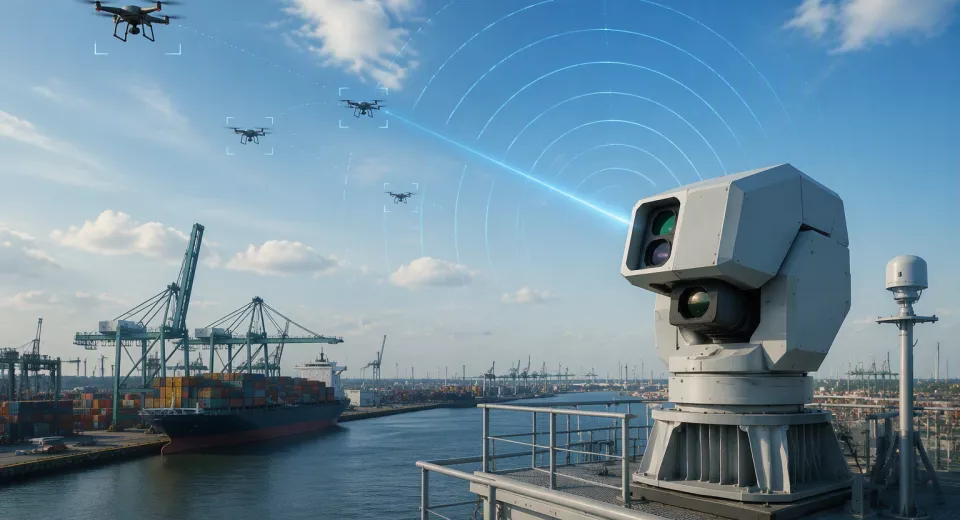
In response to this threat, the PORTSHIELD project proposes the "Sovereign C-UAS laser countermeasure system for critical maritime infrastructure." It combines a laser effector, sensor fusion, an intelligent turret platform, simulation models, and GeoAI-based deployment analyses into a single integrated demonstrator.
Objective
PORTSHIELD aims to demonstrate a practical, Belgian solution for the detection, tracking, and neutralization of drone threats around critical infrastructure.
Approach
The system combines sensors, AI-assisted threat analysis, and a laser-based effector. Through a digital twin, multi-drone scenarios are simulated, while GeoAI is used to determine optimal deployment locations and accurately assess operational range and coverage.
Partners
- OneBonsai (Coordinator): Digital twins, simulation, and AI.
- Ghent University (UGent): GeoAI and spatial analysis.
- Fergus Engineering: Laser technology.
- DOMS: Turret and sensor systems.
- Contact: Daniël Du Seuil


